Curious what your Japanese surname really means, or looking for an authentic name for a character, story, or family tree project? Ancient Japanese last names carry centuries of history, tied to clans, land, nature, and social rank. If you want a broader look at how these names work today, our guide to Japanese last names is a great starting point.
Long before Japan required surnames for everyone, only nobles, samurai, and clan leaders carried them. Each name told a story about origin, duty, or place.
Below you’ll find 150+ ancient Japanese last names sorted into samurai-era names, clan names, nature names, regional names, and more — each with a short meaning and origin.
What Are Ancient Japanese Last Names?
Ancient Japanese last names are surnames that trace back to Japan’s early clans, warrior families, and farming villages. Unlike first names, they weren’t chosen freely — they marked lineage, land, or rank.
Many ancient Japanese last names describe a family’s home, such as a river, mountain, or field. Others point to noble clans like the Fujiwara or Minamoto.
Today these names are prized for their history and sound, and many still appear in modern Japan.
Top Ancient Japanese Surnames at a Glance
| Name | Meaning | Origin |
| Sato | Help The Wisteria | Japanese |
| Suzuki | Bell Tree | Japanese |
| Takahashi | Tall Bridge | Japanese |
| Tanaka | Middle Of Rice Field | Japanese |
| Watanabe | Crossing River Edge | Japanese |
| Yamamoto | Base Of The Mountain | Japanese |
The History of Ancient Japanese Surnames
For most of Japan’s history, surnames were reserved for the aristocracy and samurai class. Common farmers and merchants used only a given name.
During the Heian period, noble families adopted uji (clan names) and kabane (rank titles) to show status. Samurai later took names from the lands they governed.
It wasn’t until the Meiji period, in 1875, that every Japanese citizen was legally required to adopt a surname, which is why ancient Japanese last names still shape family identity today.
Ancient Japanese Last Names from the Samurai Era
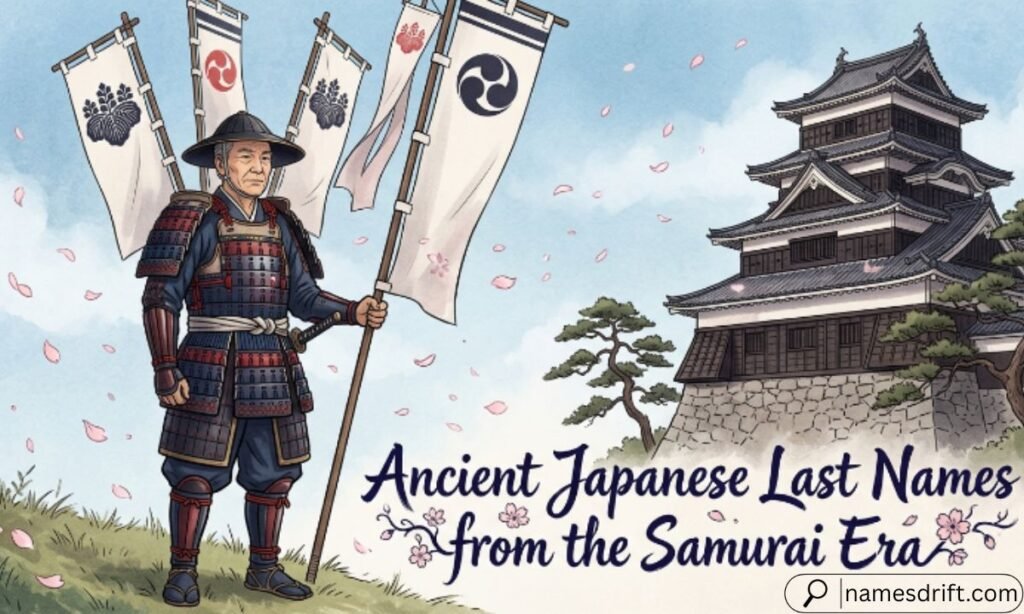
Samurai families carried ancient Japanese last names tied to loyalty, land, and honor. If bold, battle-ready names are your focus, these pair well with our list of boy names that mean warrior.
- Sanada – True Rice Field
- Honda – Root Rice Field
- Ii – Well
- Sakakibara – Sacred Tree Field
- Hattori – Cloth Weaver’s Guild
- Kusunoki – Camphor Tree
- Akechi – Bright Wisdom
- Kuroda – Black Rice Field
- Yagyu – Growing Willow Field
- Chiba – Thousand Leaves
- Nitta – New Rice Field
- Miyamoto – Base Of The Shrine
- Kato – Wisteria Increase
- Shibata – Brushwood Field
- Yamana – Mountain Name
- Kikkawa – Lucky River
- Naoe – Straight Inlet
- Kajiwara – Blacksmith’s Field
Ancient Japanese Last Names from Feudal Japan
Feudal Japan was ruled by powerful daimyo families, whose authority over their domains echoes the strength found in names that mean king, if you’re drawn to that kind of commanding legacy.
- Oda – Small Rice Paddy
- Toyotomi – Abundant Provisions
- Tokugawa – Virtue River
- Uesugi – Above The Cedar
- Takeda – Bamboo Rice Field
- Date – Wise And Elegant
- Imagawa – Present-Day River
- Hosokawa – Narrow River
- Otomo – Great Companion
- Ryuzoji – Dragon King Temple
- Amago – Descendant Of Heaven
- Asakura – Shallow Storehouse
- Shimazu – Island Harbor
- Ashikaga – Reed Field Foot
- Mori – Forest
- Hojo – Northern Clause
- Kikuchi – Chrysanthemum Pond
- Rokkaku – Six Corners
Ancient Japanese Clan Names
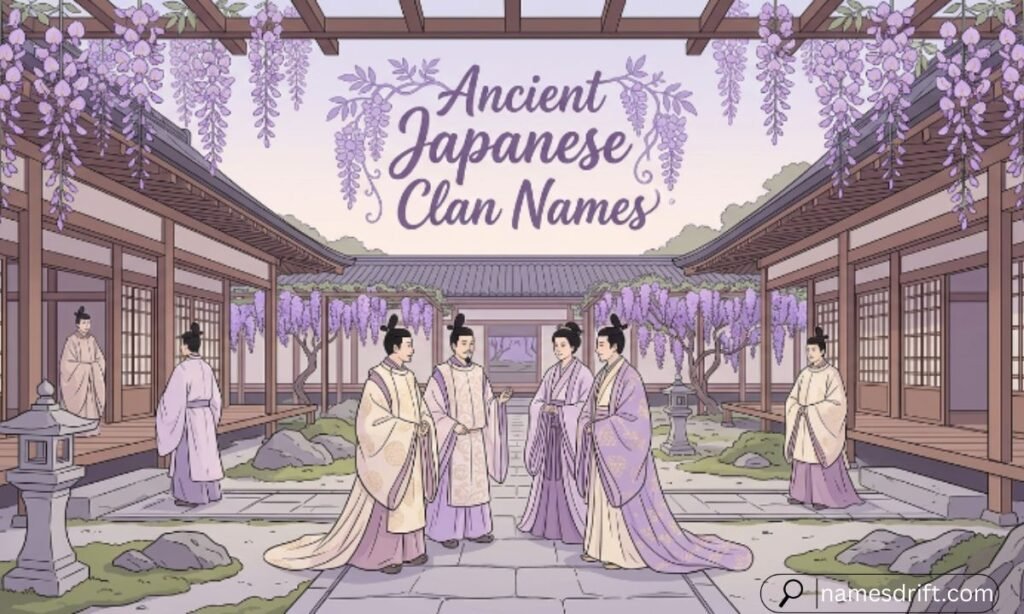
Clan names, or uji, marked descent from powerful noble houses. These ancient Japanese last names once defined an entire family’s rank at court, much like today’s popular Japanese last names still signal family identity.
- Minamoto – Origin, Source
- Taira – Flat, Peaceful
- Fujiwara – Wisteria Field
- Tachibana – Mandarin Orange Tree
- Saionji – Temple Of The West Garden
- Konoe – Inner Guard Gate
- Kujo – Nine Avenues
- Nijo – Second Avenue
- Ichijo – First Avenue
- Sanjo – Third Avenue
- Takatsukasa – High Office
- Shiba – Turf, Lawn
- Hatakeyama – Field Mountain
- Ogasawara – Small Bamboo Field
- Ashina – Reed Harbor
Ancient Japanese Last Names Inspired by Nature
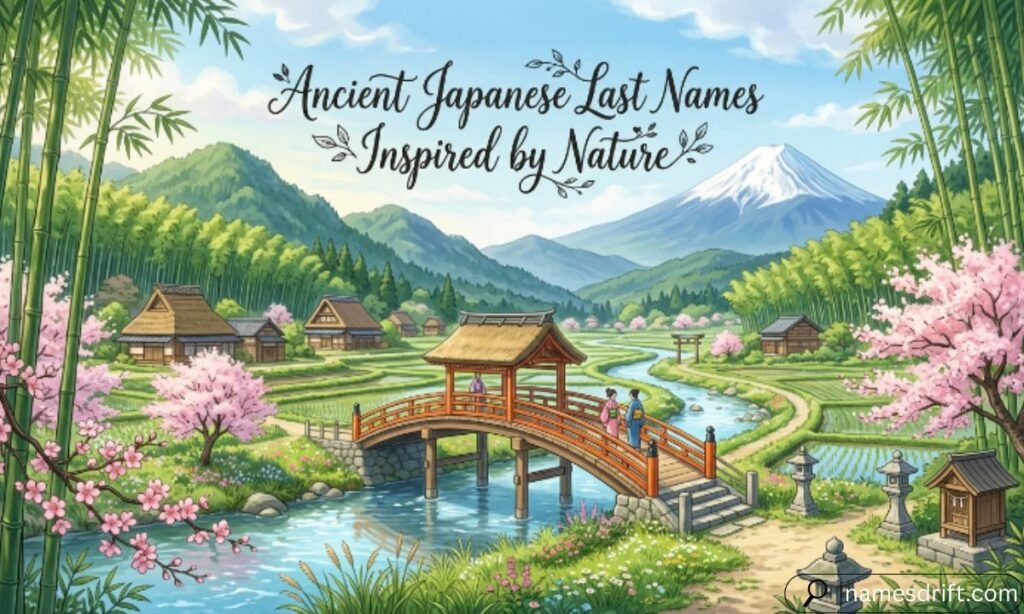
Nature shaped countless ancient Japanese last names, drawing on rivers, mountains, and blossoms found near a family’s home — a naming instinct also seen in names that mean fire, where elemental force becomes part of an identity.
- Kawakami – Upper River
- Morikawa – Forest River
- Takayama – High Mountain
- Nakayama – Middle Mountain
- Kawabata – Riverside Edge
- Umeda – Plum Blossom Field
- Sakurai – Cherry Blossom Well
- Matsuda – Pine Tree Field
- Fujimoto – Wisteria Base
- Momoi – Peach Tree Well
- Iwai – Rock Well
- Taketani – Bamboo Valley
- Kumagai – Bear Valley
- Yamazaki – Mountain Point
- Hoshino – Star Field
- Kawano – River Field
- Ishibashi – Stone Bridge
- Takenaka – Inside The Bamboo
More Ancient Japanese Surnames Worth Knowing
| Name | Meaning | Origin |
| Nakamura | Middle Village | Japanese |
| Kobayashi | Small Forest | Japanese |
| Yoshida | Lucky Rice Field | Japanese |
| Ishikawa | Stone River | Japanese |
| Matsumoto | Base Of Pine Tree | Japanese |
| Kimura | Tree Village | Japanese |
Ancient Japanese Last Names Still Used Today
Many ancient Japanese last names never faded — they’re common surnames across Japan today, still linking modern families to old roots, similar to how rare Japanese last names preserve less common but equally old lineages.
- Nakajima – Middle Island
- Maeda – Front Rice Field
- Fujita – Wisteria Field
- Ogawa – Small River
- Goto – Back Wisteria
- Okada – Hill Rice Field
- Hasegawa – Long Valley River
- Murakami – Upper Village
- Kondo – Near Wisteria
- Ishii – Stone Well
- Sakamoto – Base Of The Slope
- Endo – Distant Wisteria
- Aoki – Blue-Green Tree
- Fujii – Wisteria Well
- Nishimura – West Village
- Fukuda – Fortune Rice Field
- Ota – Big Rice Field
- Miura – Three Inlets
How Ancient Japanese Surnames Changed Over Time
- Ancient Japanese last names evolved as Japan’s social structure shifted.
- Clan names gave way to land-based names once samurai settled on specific territories.
- After the Meiji decree of 1875, farmers and merchants finally chose or registered surnames, often borrowing from nearby geography, occupations, or old family ties.
- This blending of noble, warrior, and common naming traditions is why today’s Japanese surnames range from grand clan names to simple, nature-based ones.
Ancient Japanese Last Names with Traditional Meanings
These ancient Japanese last names carry clear symbolic meanings tied to virtue, land, or family values passed down through generations.
- Yamashita – Below The Mountain
- Nakano – Middle Field
- Harada – Field Of The Plain
- Ono – Small Field
- Tamura – Rice Paddy Village
- Takeuchi – Inside The Bamboo Grove
- Kaneko – Child Of Gold
- Wada – Harmony Rice Field
- Ishida – Stone Rice Field
- Ueda – Upper Rice Field
- Morita – Forest Rice Field
- Hara – Plain, Open Field
- Sakai – Boundary, Border
- Kudo – Nine Wisteria
- Yokoyama – Side Mountain
- Miyazaki – Shrine Cape
- Uchida – Inside Rice Field
- Takagi – Tall Tree
Ancient Japanese Last Names by Region
The region shaped many ancient Japanese last names, especially in Okinawa, where naming traditions differ from mainland Japan.
- Higa – East River Bank
- Shimabukuro – Island Storehouse
- Miyagi – Shrine Castle
- Uema – Upper Rice Field
- Gushiken – Excellent Sword
- Nakasone – Middle Root
- Chinen – Thousand Years
- Aso – Friend’s Nest
- Yano – Arrow Field
- Matsubara – Pine Field Plain
- Sasaki – Small Ravines
- Abe – Northern Section
- Kishimoto – Base Of The Shore
- Yokota – Side Rice Field
- Nishikawa – West River
- Shibuya – Bitter Valley
- Kawaguchi – Mouth Of The River
- Anzai – Peaceful West
- Fukushima – Fortune Island
- Nagano – Long Field
Famous Ancient Japanese Last Names
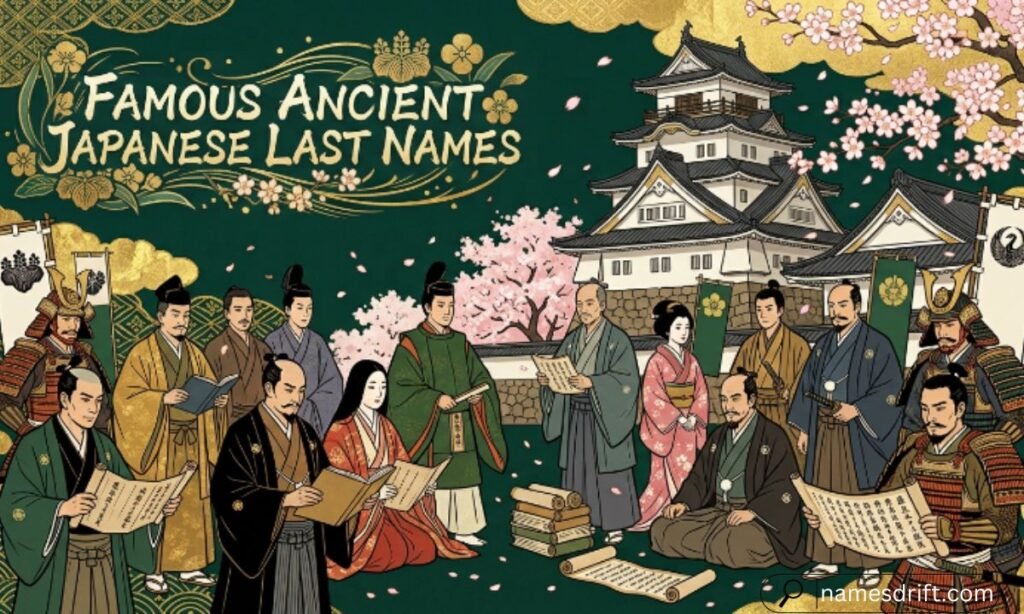
Some ancient Japanese last names became famous through the historical figures who carried them into Japan’s political and military history.
- Saigo – West Countryside
- Katsu – Victory
- Iwakura – Rock Storehouse
- Okubo – Large Storehouse
- Kido – Wooden Door
- Ito – Wisteria Vine
- Terauchi – Inside The Temple
- Nogi – Field Of Trees
- Togo – Eastern Countryside
- Yamagata – Mountain Shape
- Matsudaira – Pine Peace
- Konishi – Small West
- Otani – Large Valley
- Nabeshima – Cooking Pot Island
- Yamauchi – Inside The Mountain
Tips for Choosing an Ancient Japanese Last Name
- Pick an ancient Japanese last name that’s easy to pronounce and matches the tone you want, whether soft and poetic or bold and historic.
- For characters or usernames, nature-based names feel gentle, while clan and samurai names sound stronger and more dramatic.
- Always double-check the meaning and origin before using a name, especially if it’s meant to represent real Japanese heritage.
Frequently Asked Questions
What is the oldest type of Japanese surname?
Uji, or clan names like Fujiwara and Minamoto, are among the oldest Japanese surnames.
Can I use an ancient Japanese last name for a fictional character?
Yes, nature and samurai-era names work well for fictional or game characters.
Are ancient Japanese last names still used in Japan today?
Many, like Sato, Suzuki, and Takahashi, remain the most common surnames in Japan.
What makes a Japanese last name sound more traditional?
Names tied to nature, land, or old clans usually sound the most traditional.
Is it okay to use a Japanese surname as a username?
Yes, short nature-based names like Hoshino or Kawano work well as usernames.
Conclusion
Ancient Japanese last names offer a rare mix of history, meaning, and sound that’s hard to find elsewhere. From noble clans to humble village names, each one tells a small story, not unlike the moodier appeal found in unique Japanese names that mean darkness for those wanting a different tone.
Whether you’re building a character, researching family roots, or just love the sound of these names, this list gives you plenty to explore — and if you’re pairing a surname with a strong first name, girl names that mean warrior are worth a look too.
Take your time, read the meanings closely, and pick the name that feels right for your purpose.

I’m Devon, a writer passionate about exploring the world of names and their meanings. For the past four years, I’ve been creating content in the names niche, helping readers discover unique, meaningful, and creative name ideas. I cross-check name origins and meanings across multiple sources before publishing, so every list is both creative and reliable. My goal is to make name exploration simple, engaging, and inspiring for everyone.